Walk south from the Rosemary District into downtown Sarasota on a Tuesday morning and you will cross Fruitville Road without much ceremony. There is no gate, no marker, no obvious hinge between the two. For years the two neighborhoods have behaved like separate errands rather than one continuous stroll. That is changing on one specific street, and the reason is not a rezoning notice or a city planning memo. It is a restaurant.
Balos, a Mediterranean spot that built its name in Washington D.C.'s Dupont Circle, announced in mid-August 2026 that its first Florida location will open in spring 2027 inside The Edge, a ten-story condominium rising at the corner of Cocoanut Avenue and Fruitville Road. That single announcement, placed at that single intersection, closes a loop that has been building along Cocoanut Avenue for more than a decade. If you already live in downtown Sarasota or the Rosemary District, the corridor you think of as two neighborhoods is becoming one.
The corner that used to be a gap
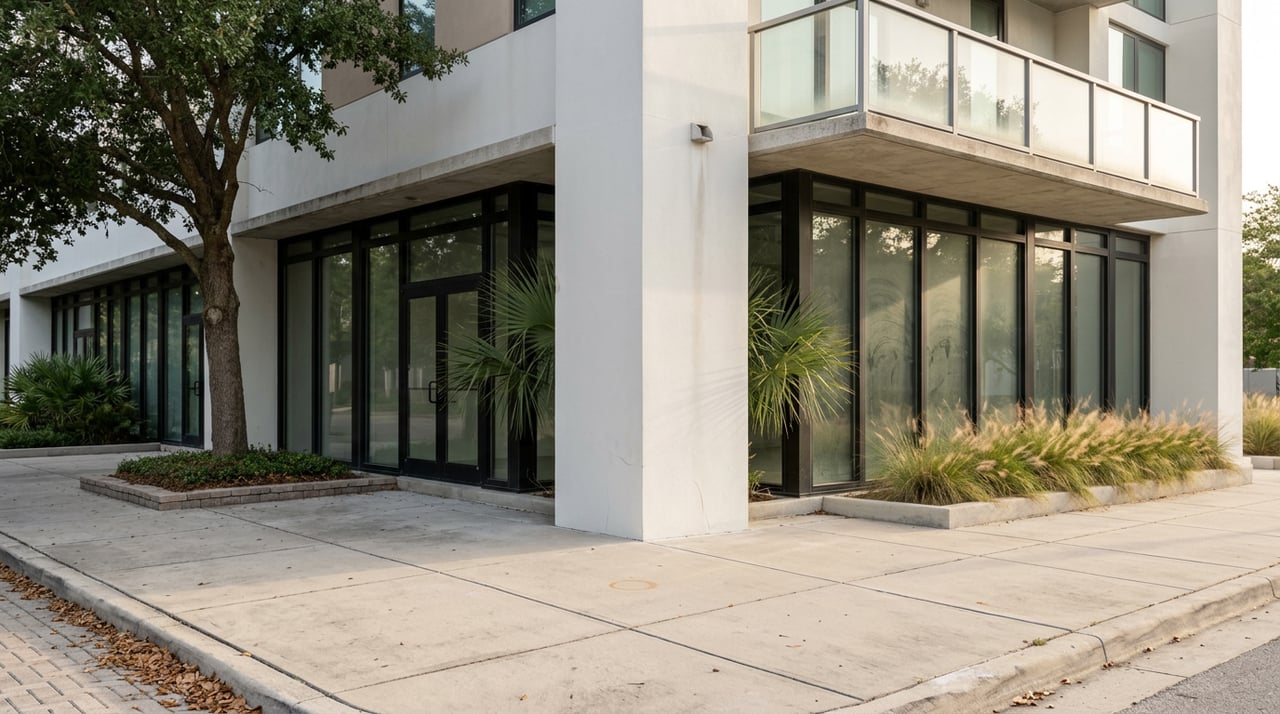
The Edge sits on a 27-residence footprint, with units starting at just under $3 million, and the building topped out in late 2025. First residents are expected to move in this fall of 2026. Balos will occupy roughly 7,200 square feet on the ground floor, the building's only retail tenant, open to the public rather than reserved for residents.
What makes the location notable is not the restaurant itself but where its developer chose to put it. Lee Smith is a partner at ORE Development alongside Sadek Omar. The Edge occupies a corner between downtown and Rosemary, a placement that makes it seem less like the edge of either neighborhood than a seam between them. In a report announcing the project, Patch quoted Smith: "Our focus is on attracting exceptional operators and experiences that enhance downtown Sarasota for residents and visitors alike." Its public-facing restaurant may give people a reason to cross.
One developer, two ends of the same idea
The Edge is not an isolated bet. Its development team also has a stake in a considerably larger project a few blocks away at Five Points, where Jebcore Companies is working with WMG Development and Hilton to convert the former Zenith office complex into Waldorf Astoria Residences. That project is a different scale entirely, but it shares a developer, a neighborhood, and the same underlying bet: that the stretch of downtown Sarasota bordering the Rosemary District is worth building toward from both directions at once.
That is the detail easy to miss if you only read the restaurant headline. One developer is now anchoring two separate corners of the same half-mile, which is a stronger signal than either project would be alone.
Half a mile that already had momentum
None of this happened overnight, and it did not start with Balos. The Rosemary District's density rules changed in 2014, when the city raised allowable density from 25 units per acre to 75, and that single zoning change is what triggered the building wave the neighborhood has seen since. By 2017, more than 1,500 residential units in the district were built, approved, or awaiting approval, a pace that had already earned the neighborhood a ranking that year among Florida's ten most walkable.
Cocoanut Avenue itself has been the spine of that growth. A short list of what already anchors the street:
- CitySide Apartments, a four-story, 228-unit complex at 700 Cocoanut Avenue built by Longboat Group and credited with ushering in Sarasota's apartment-building boom
- BaySide, a five-story, 254-unit project planned for 850 Cocoanut Avenue on a 3.5-acre parcel that sold for $15.5 million in March 2024, designed to include its own restaurant and a small retail market
- Great Heights Creamery and Parkside, a food and beverage compound on nearby Central Avenue, both of which had just opened as of spring 2024
Josh Weiner, principal at Longboat Group, has said BaySide took more than five years from concept to groundbreaking, originally imagined back in 2019. That kind of timeline is normal for infill development in a district this dense, and it explains why the corridor has felt like a slow accumulation rather than a single dramatic reveal. Put the milestones in order and the shape becomes clear:
- 2014: Rosemary District density overlay raised from 25 to 75 units per acre
- 2019: BaySide first conceived by Longboat Group
- March 2024: BaySide's 850 Cocoanut Avenue parcel sells for $15.5 million, project announced with groundbreaking to follow
- Early 2024: Great Heights Creamery and Parkside open on Central Avenue
- Late 2025: The Edge tops out at Cocoanut and Fruitville
- Fall 2026: First Edge residents expected to move in
- August 2026: Balos announced for The Edge's ground floor
- Spring 2027: Balos expected to open
Read that way, the restaurant announcement is not the start of something. It is the moment a decade of separate projects on the same street started to read as one plan.
What changes for someone already living here
If you live in the Rosemary District today, your walk to a sit-down dinner has mostly meant heading south past Fruitville into downtown proper, or picking from what already exists on Central Avenue at Parkside. Once Balos opens in spring 2027, that walk gets a reason to stop at the border rather than cross it. The same logic runs in reverse for downtown residents who have treated Rosemary as a neighborhood you drive to rather than one you wander into after dinner.
This is the kind of shift that shows up in foot traffic patterns before it shows up in any official designation. A restaurant that treats the sidewalk in front of it as a destination rather than a pass-through changes how people route their evenings, block by block. Add BaySide's own restaurant and market, whenever that project completes, and Cocoanut Avenue starts to look less like a connector street and more like a short commercial strip in its own right, bookended by CitySide on one end and The Edge on the other.
None of this depends on either project turning a profit or hitting its stated timeline exactly. The Rosemary District Association's own map lists more than twenty buildings inside a neighborhood the association describes as under half a mile across in either direction, bounded by Fruitville Road, Tamiami Trail, 10th Street, and Orange Avenue. That is a small enough footprint that a single new restaurant at one corner genuinely changes the internal geography of how residents move through it.
A street becomes a spine
The interesting part of this story is not that Sarasota is getting another restaurant. Restaurants open and close constantly along the Suncoast, and most of them do not reshape how a neighborhood organizes itself. What makes Cocoanut Avenue different is that the same corridor now has anchors at both ends. Together, the projects may help the street function as a bridge rather than a boundary, a possibility worth paying attention to if you already call either neighborhood home.
For residents, the practical upshot is simple. A street you may have thought of as a drive-through connector between two destinations is becoming a destination of its own, one restaurant and one residential lobby at a time.
If you are watching how downtown Sarasota and the Rosemary District are growing into each other, or you are weighing what a home along this corridor might mean for your own daily routine, Brenda Wolfe knows this stretch of the city block by block. Let's talk about your next move, schedule a consultation, and walk the corridor together before you decide where you want mornings and evenings to happen.
This article is general information, not legal, tax or financial advice. Consult a qualified professional about your situation.